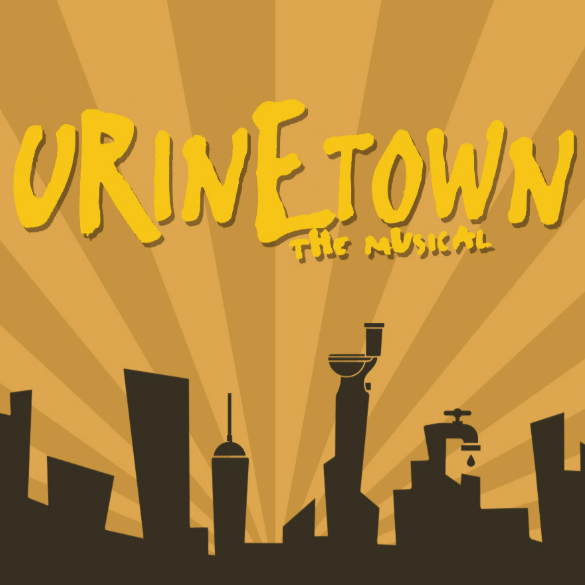
‘Urinetown’ the Musical: a Dramaturgical Statement
Dramaturgy plays a key component in the world of storytelling. To put it simply, it provides us with historical background and contextual understanding. In doing so, dramaturges inevitably become pioneers for social and cultural awareness. Dramaturgy is based on research and analysis. It asks you to examine the different layers of a given show, whether it be its historical, social, cultural and/or political backbone. More so, it encourages us to take that new-found knowledge and apply it to ourselves, as thespians and as people.
Urinetown, an irreverent-social satire musical by Greg Kotis and Mark Hollman, tells the story of a dystopian community suffering from a water shortage caused by a twenty-year drought. In the world of Urinetown, people are poor and government officials take the lead, banning private restrooms and instating the infamous law that one must pay… in order to pee. Resembling the original 2001 Broadway production, director Robert Esposito also chose to implement the Depression Era as the historical backdrop in this production ofthe show.
So, why is this important?
Having a comprehensive understanding of the time period allows production members to construct a visually cohesive piece. While a costume or set designer might focus on aesthetic elements of the 1930’s, an actor might utilize research to help them develop well-rounded characters and back-stories. They might ask themselves a series of questions like:
What time period did I grow up in?
What social class does my family fall into? Are we wealthy? Poor?
In the long run, research can also help us better understand the given circumstances that surround our characters story: why am I holding this picket sign? Why is it so important that I protest? What is at stake? As an actor, I also tend to ask these very same questions when doing a show myself. Simply put, knowledge about the history and the context of a show alters the way that your character acts and talks and interacts with others. It inevitably changes who you become on stage.
In essence, all thespians are dramaturges. I mean, we have to be, don’t we?
Okay. So, you’ve done your research. Now what?
When it comes to dramaturgy, evaluating our information is key for it encourages us to think critically about a given topic, time period or issue. A large portion of our Dramaturgy CAS Class (Cooperative Arts High School’s after-school program) would be dedicated to research and discussion. I’d give my students topics to study and we’d later come together to talk about them. In creating a conversational atmosphere, we were able to draw parallels between our findings and elements in the show, whether those be aesthetic or thematic. In essence, dramaturgy serves as a platform for discussion. It allows us to take a piece of art and delve into its thematic undertones:
What message is this production trying to convey?
How does this affect us? How does it affect a community?
In what ways does it concern our political and social climate?
Musical theatre, like any art form, has become a platform for self-expression and entertainment, but more importantly, it has become a direct means for storytelling. Some may argue that art reflects life, and theatre certainly celebrates that. It adheres to a conventional form of storytelling: an illusion that what we see on stage could just as well mirror our own realities. More so, realistic characters and circumstances are what we’re mostly drawn to, particularly because they closely reflect human nature (and that’s clearly something we identify well with). In the case of Urinetown, writers Greg Kotis and Mark Hollman had other intentions. Written in a theatrically extreme style, one that is said to closely mirror those of Bertolt Brecht’s, Urinetown departs from traditional theatre only to transcend into a blatantly unconventional form of storytelling.
Bertolt Brecht, a German dramatist, became a theatrical pioneer when his unconventional theories surfaced in the early twentieth century. He believed that audiences should never emotionally attach themselves to stories or characters but view them impartially, in order to think critically about their social relevance. In diverting from conventional forms of theatre, he introduced an exaggerated style, one that belittled emotional value and prioritized social importance. This notion became known as epic theatre, a style that came to fruition through techniques that would sequentially exaggerate the tone of a show. Such techniques included breaking the fourth wall and the use of satire. In having characters address the audience and ridicule political or social concepts, he was able to shed a light on them. In turn, audiences would be able to think about those issues objectively rather than emotionally.
In the case of Urinetown, epic theatre serves as the foundation for humor, parody and political awareness. This form of satire is carefully and strategically curated into the context of the show, leaving us contemplating its underlying themes. When it comes to political commentary and social satire (as it presents itself in a theatrical space), Greg Kotis and Mark Hollman take the lead. Through sardonic lyrics, derisive dialogue and a generally irreverent plotline, Urinetown explicitly outlines issues surrounding Capitalism, government control, freedom of speech and the intricate connection between wealth, power and poverty. This use of satire is brilliant in that it makes us laugh but it also makes us think. It exploits controversial and often times flawed structures and ideas in a way that that capitalizes humor, deeply reflective of our human need to inappropriately laugh at things that feel bizarre and generally out of our control.
As the famous quote states,
“Well, I’ll tell ya, you know, it’s touching. Like a lot of things in life, we laugh because it’s funny and we laugh because it’s true.”
– The Untouchables (1987, delivered by actor Robert De Niro, personifying the infamous Al Capone).