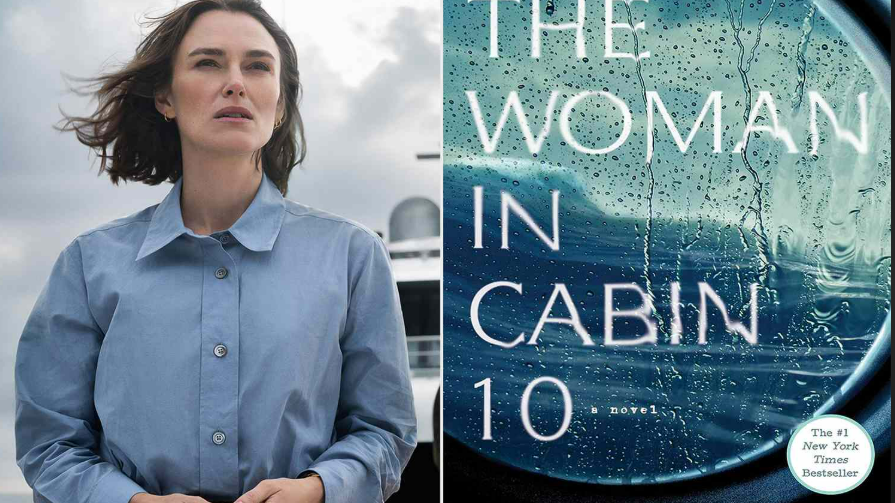
From Scene to Screen: ‘The Woman in Cabin 10’
The Woman in Cabin 10, a psychological thriller written by Ruth Ware, follows Laura “Lo” Blacklock, a travel journalist, ridden by anxiety and recent traumas. She’s assigned to cover the maiden voyage of the Aurora Borealis, a luxury yacht owned by Norwegian elitist, Richard Bullmer.
Alongside a select group of European professionals, Lo joins this sea excursion in an attempt to scale up at Velocity, the travel magazine she works for. Her trip takes an unexpected turn when she witnesses a shocking crime, on her first night aboard the cruiser.
The book follows a series of suspenseful moments as Lo tries to grapple with what happened and solve the ultimate crime: who is the woman she saw in the cabin next to hers and how exactly does she fit into this pending mystery?
A Funky Film Adaptation
Netflix released a film adaptation (by the same name) on October 10, 2025. Directed by Simon Stone, the film follows the same story but exposes a plethora of narrative discrepancies. Let’s talk about some of the biggest differences between the book and the movie. HEADS UP: *the following contains spoilers*
Exposition: No Judah, No Burglary & Lo’s Invitation
For starters, the movie doesn’t include Judah, Lo’s faithful partner, who serves as a fundamental source of communication between Lo’s parents, friends and media outlets when they can’t reach her during her expedition. While I can understand the choice for leaving him out, I can also understand why it would have been important to keep him in. His contribution to the story offers readers moments of tension and heightened suspense.
A key moment in the book’s exposition is the robbery that Lo experiences, prior to her voyage. This sets a precedent for the thriller’s anxious tone and exposes Lo’s mental health history, an important factor that comes into play later on. In the movie however, Lo Blacklock, played by English actress Keira Knightley, doesn’t experience a burglary at all. Alternatively, her supervisor (Gugu Mbatha-Raw) tells her she needs a break from work. This implies that something happened but we don’t know what. The importance behind detailing the burglary prefaces Lo’s emotional distress, contributing to her existing mental health struggles. In later moments of the book, this is used as a weapon against her: passengers question her mental stability, and as a result, question her testimony about the accident she claims to have witnessed.
Another major difference between the book and the movie is the way in which the Aurora Borealis is introduced. In the movie, Lo’s character is honorably invited, implying that she maintains a sort of rapport with Richard Bullmer (which is completely untrue). In the book, she is originally assigned to cover the trip for her supervisor (who is currently on leave). While the difference is not detrimental, it does change the trajectory of Lo’s objectives, which has always been to scale up as a journalist.
Rising Action: Carrie’s Character & AI Facial Recognition
The deeper we get into the film, the more changes we see. In the movie, Carrie’s character is introduced through a completely different lens. She is hand-picked by Richard Bullmer through an AI Facial Recognition software to take part in his scheme. While this doesn’t inherently change Bullmer’s objective, it does alter Carrie’s character completely. In the book, her aggressive demeanor stems from a place of love and the yearning to protect the man she has fallen in love with. In the movie however, her demeanor is much more fragile and emotionally erratic. By having been selected through the AI Facial Recognition software, she is essentially at the mercy of someone else’s control. She has been chosen to do a job and her life could very well be at risk if she fails to do it incorrectly. This alteration intrinsically changes the tone of her personality, contributing to an intensely vulnerable and submissive character.
I would say this was probably one of the biggest differences for me, as it vastly altered the way in which Carrie made decisions, differing drastically from those in the book and contributing significantly to changes in the plot.
Turning Point: No Clothing Swap & The Will Signing
Another difference that transformed the plot and ultimately, the entire ending of the movie, was the clothing swap between Lo and Carrie. In the book, this swap takes place in the bunker where Lo was kidnapped. It happens after Carrie opens up to her: having shared her story and details surrounding what has led her to this particular moment of her life. Choosing to save Lo instead of harming another person, Carrie suggests they swap clothes, so Lo can look like her and escape the yacht, without running the risk of being questioned by any of the onboard staff. The swap represents a clear objective on Carrie’s part, signifying her choice to save another life.
The movie however, takes a wildly different turn.
Carrie is seen on a lifeboat (dressed as Anne), alongside Richard Bulllmer, on their way to sign her Will. This brings me to the next point.
Anne’s Will was not particularly referenced in the book but it sure seems to make up a large portion of the film’s ending plotline. In the movie, Carrie (impersonating Anne) is seen signing her Will, signifying that Anne’s fund and accompanying profits have now been formally turned over to Richard.
From this point on, the movie seemingly takes on a brand-new narrative, differing drastically from the original story.
Falling Action: The Gala & Carrie’s Survival
Following these (newly changed) turning points, the movie culminates in a final gala scene, commemorating Anne and her successful fund.
In a completely random (and newly added scene), Lo enters the ceremony, where she confronts Richard, Carrie (dressed as Anne) and all of their (rightfully) confused guests. In a turn of events, Carrie takes Lo’s side and together they decide to expose Richard’s lies in front of everyone. This moment escalates, leading up to Richard’s death … and Carrie’s survival.
While Richard’s death is strongly implied in the book, Carrie never survives. This is a newly fabricated ending, one that serves as an alternate conclusion to an already confusing plotline.
Final Thoughts
When I first heard about The Woman in Cabin 10, I became very interested in the story and I couldn’t wait to pick up the book and start reading it! Unfortunately, it did not live up to its expectations.
The book fell flat, introducing high stakes characters with low-stake objectives. Character motivations felt bleak in comparison to highly intense circumstances and bubbling dynamics. I suspect this is why the movie incorporated so many changes.
While the film modified scenes and applied changes throughout, I did enjoy it better than I enjoyed the book. Least to say, they both disappointed on some level but when it came to the movie, I thought hey, at least it made a little more sense.