From Scene to Screen: People we Meet on Vacation, a Review
When it comes to rom-coms, Emily Henry knows how to deliver. Her books intertwine the complexities of love and romantic relationships, amidst contrasting circumstances and contemporary settings. To put it simply, she writes about what we feel, what we yearn for and what most of us have likely experienced.
People we Meet on Vacation is no different. Emily Henry’s contemporary novel paints a colorful picture, one that spans a twelve-year friendship and offers an intimate look at the platonic relationship between two drastically different people. On the surface, Alex and Poppy couldn’t be any more different. She’s a free spirit, constantly looking to travel and connect with other adventure seekers, while Alex, on the other hand, wants to settle down and build a family of his own. In the course of 382 pages, we see their differences explained, their similarities unfold and the love they share for one another catapult into something substantial and romantically meaningful.
From Scene to Screen: A Fantastic Film Adaptation!
Netflix released a film adaptation and People we Meet on Vacation, starring Emily Bader (Poppy) and Tom Blyth (Alex), premiered on Friday, January 9, 2026. Directed by Brett Haley, the film pays tribute to the original story, honoring its narrative and beloved characters.
Let me begin by saying this: I couldn’t stop smiling when I saw this movie. As a fan of the book, I was pleasantly surprised with this adaptation, as I thought it genuinely respected the novel and the heart of its beautiful characters.
Changes that Enhanced & Complimented
A film adaptation will always come with some form of cinematic change or narrative adjustment. It’s inevitable. Readers should make an effort to remember this before stepping into a movie theater (or in this case, hopping on their couches to stream watch the beloved Netflix rom-com).
For starters, a film adaptation of any book is just that: an adaptation. It’s not a carbon copy of the novel but rather, a closely mirrored version of the original story. Film adaptations (including this one) need to be condensed significantly, as you’re taking a 300+ page story and translating it into a 2-hour(ish) movie. It’s impossible to include every detail of your favorite segments or chapters. Things will get lost along the way or might be re-structured in a way that serves the timeline of a film production.
I like prefacing with this statement because yes, People we Meet on Vacation did in fact include some changes. In my opinion, however, they were changes that complimented and brilliantly enhanced the version we got to see on screen. Let’s talk about some of them!
Palm Springs vs. Barcelona
In the book, the present-day scenes take place in Palm Springs, California. In an effort to reunite with Alex after a two-year stint in their friendship, she lies and tells him that R+R, the magazine she writes for is sending her to Palm Springs for a work obligation (where Alex’s brother David, happens to be getting married). One of the more notable changes in the movie came when we find out that Poppy is actually invited instead. Oh, and that the wedding is now taking place in Barcelona, Spain.
These changes didn’t really affect me (or the trajectory of the story) in any way. On a surface level, I was actually pleasantly surprised at the shift in location, seeing as Barcelona feels like a generally more romantic destination. Plotline wise, they actually found a way to tie in Poppy’s “lie,” which honored the original story perfectly. In the movie, Poppy is seen at a spin class with her friend Rachel (Alice Lee). She calls Alex to tell him that she won’t be attending the wedding, in an effort to avoid any pending awkwardness between the two of them. She uses work as an excuse, and when Alex asks her where R + R is sending her, she spontaneously answers with “Barcelona.” And so, the plot continues. This is a great example of how book-to-film changes aren’t always negative. You can change, adjust or adapt something while maintaining the essence of what the book showed us in the first place.
Shorter Present-Day Scenes
While Palm Springs serves as the wedding location in the book, it also serves as a catalyst for Poppy and Alex’s reunion: she’s planning this trip with him, in an effort to re-connect. As a result, we follow a great deal of their Palm Springs itinerary during these present-day scenes. The reason we don’t see so much of this in the movie, is due to the fact the Barcelona trip is no longer something they planned together. While this poses a change, it doesn’t alter the trajectory of their objectives or intentions in any way. We know Poppy still cares for Alex and longs to see him again. The way they are brought together might differ from book to film, but the intention behind their reunion is still the same: they miss each other.
This shift also justifies the shorter present-day scenes we witness between the two of them in Barcelona. In the movie, their trip is individual: they are there for the same reason but they are not there together, so there’s no longer an itinerary for the two of them to follow. It makes sense that all of their scenes (before wedding-related obligations) fall on the shorter side.
Amazing Additions: Skinny-Dipping and a Super Flirty Dance Sequence
In Netflix’s People we Meet on Vacation, some additional scenes were added along the way and I’m just here to say, that they were simply amazing! I want to bring attention to two of them, the first one being Alex’s skinny-dipping adventures during their early-on camping trip. This scene… and the following (the one in the woods where they share a laugh after naked Alex attempts to cover up with Poppy’s tiny romper) pays tribute to the comfort, familiarity and lightheartedness that co-exists between the two of them. This dynamic is significantly prevalent in the book, and I’m happy that they honored it, through a series of new scenes in the movie.
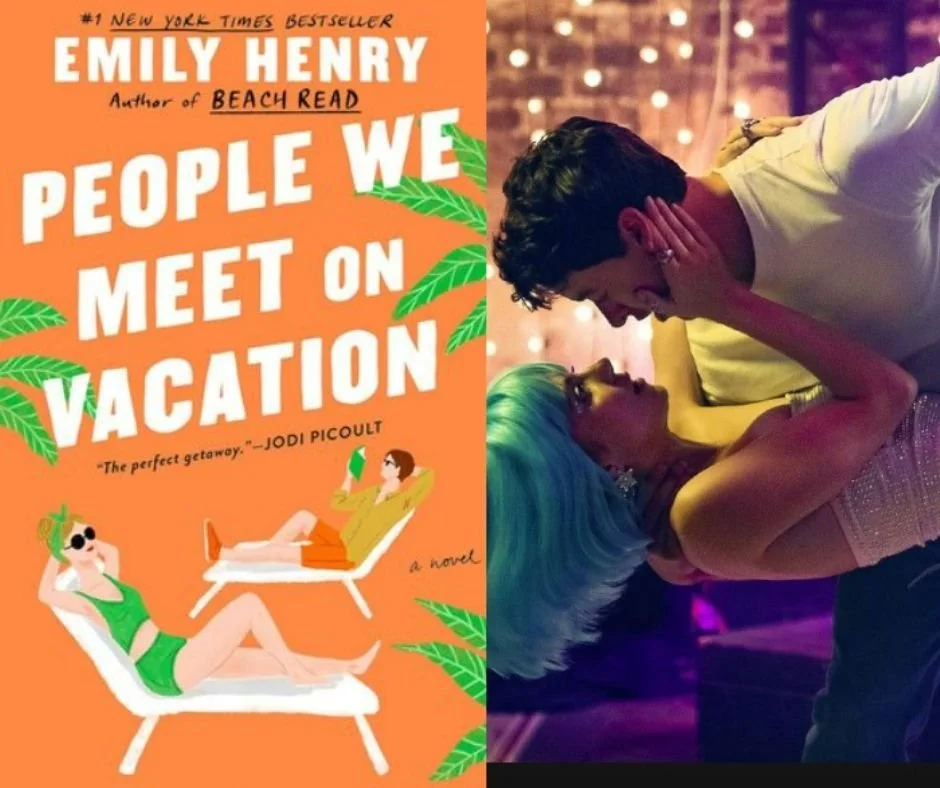
Another addition was the New Orleans dance sequence. This is one of those scenes that makes a rom-com, embodying the flirty, playful and sensual characteristics that encompasses this style and genre of film. In a local New Orleans bar, we see Poppy dancing to a Paula Abdul song (‘Forever your Girl’) and giving Alex a teasing nudge in an effort to get him to dance along with her. He steps on the dance floor and awkwardly begins to move his body (in the most perfect Alex Nilsen way). When she nudges him further, he responds with “okay, you asked for this,” … and I think we can all agree that it was a good thing she did. Tom Blyth’s dance moves are a wonder to watch and will forever be imprinted in our minds (and in our hearts). I couldn’t stop smiling when I saw this moment in the movie. The combination between the soundtrack, the iconic blue wig, the club-like lighting and the flirtatious push and pull of their dance offers audiences a sort of beautifully chaotic moment, while simultaneously enhancing the essence of these characters, their mutual comfort, and the chaotic feelings they harbor inside.
Crazy Good Casting
I want to take a moment and bring attention to the casting of this film, which was nothing short of spectacular. Alex and Poppy differ drastically from one another, so it was important to pick actors that could embody these contrasting traits in a visually entertaining way. Simply put, Emily Badar and Tom Blyth were phenomenal in these roles. Their natural ability to breathe life into their characters felt effortless and completely in-tune with the characteristics that define who they are in the first place.
Emily Bader brings such a playful innocence to the role of Poppy. We see this in scenes like the one where Poppy and Alex meet for the first time, back in college. She’s bubbly, funny, talkative, charismatic and incredibly un-filtered. These are fundamental character traits depicted in Emily Henry’s book, so to see it embodied perfectly on screen was a joy to watch.
Throughout the years, we see Poppy evolve and we certainly see Bader evolve with her as she embodies elements of change and growth, while maintaining who she is, at the core: playful, quirky and deeply loving. Because the story takes place throughout the course of twelve years (nine in the film), we play witness to differing versions of these characters, as time goes on. It’s like seeing a person grow up, right before your eyes. Bader and Blyth accomplish this subtly and naturally. We see these changes and character shifts personified on screen through mannerisms, body language and understated variations in tone of voice, especially as the characters begin to mature. These shifts really play into the time lapse that exists in the story, particularly in scenes where we transition back and forth between present day and previous years.
Characters Brought to Life
I appreciated how certain artistic, directorial and improvisational choices were made to accentuate the traits that predominantly characterize these roles. Moments where Tom Blyth communicates through stiff body language, tense lip purses and yearning eyes are some of my favorites. These choices breathed so much life into the character of Alex, in a way that truly honored the essence of who he is and what his heart holds inside.
Instances like the one in the motel bathroom (where Alex is flossing his teeth) or the moment where he bumps his head against the trunk of his car are other examples that capture his spirit and authentically pay tribute to his Type-A personality. These scenes were wonderfully thought out and beautifully placed in.
A Must Watch
Netflix’s People we Meet on Vacation felt like an homage to the classic rom-com, with scenes, narrative fragments and cultural influences that referenced movies like Dirty Dancing and When Harry Met Sally.
Through a series of romantic lines, emotional confessions and visually stimulating scenes (original and new), People we Meet on Vacation sets a precedent for friendships everywhere and reminds us how powerful the love between two people can be. It’s a story about growing up and growing together and how sometimes, a platonic friendship can help unveil the deeper intricacies of your own life and what it is you’re looking for, in the end. People we Meet on Vacation is a must watch (and a must read) for rom-com lovers everywhere!