Pretty Lethal, a Film Review
In a world full of stereotypes and premeditated assumptions, Pretty Lethal, challenges our thoughts and asks us to re-consider what we believe to know about ballet dancers… and people as a whole.
Pretty Lethal Cast
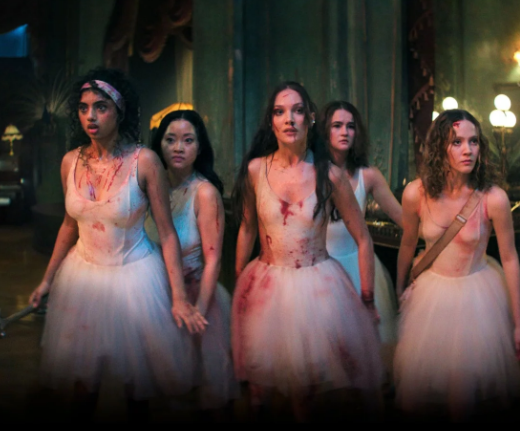
Dance Mom’s Maddie Ziegler stars as “Bones,” alongside a fierce group of fellow ballerinas including Lana Condor (To All the Boys I’ve Loved Before), Avantika (Mean Girls 2024), Millicent Simmonds (A Quiet Place) and Iris Apatow (Funny People, Knocked Up).
Cinema legend Uma Thurman (Pulp Fiction, Kill Bill) leads an antagonist group of Hungarian criminals, as the washed up and resentful ex-dance prodigy, Devora Kasimer.
What is Pretty Lethal About?
includes some spoilers
Directed by Vicky Jewson, Pretty Lethal tells the story of five American ballerinas, who take shelter in a sinister looking inn, on their way to an international dance competition in Budapest, Hungary.
When their 1960’s looking bus breaks down in a secluded jungle-esque street of Hungary, the girls and their dedicated dance teacher Miss Thorna (played by Lydia Leonard), decide to leave the scene, in an effort to find help. In the process, they stumble upon a mysterious looking inn, later to discover that it’s managed by a mob of Hungarian criminals. Weird things start to happen and the girls begin to witness a series of uncanny moments, for starters: the murder of their dance teacher, Miss. Thorna.
When the girls realize this isn’t your everyday wholesome bed and breakfast, they rally together in an effort to escape. Along the way, we witness a variety of gore-infused scenes, criminal activity and intricately choreographed ballet dance sequences.
A Tribute to Crime Films
Pretty Lethal is a psychological horror thriller, one that aesthetically mimics similar choices to those of Quentin Tarantino’s crime films. Pulp Fiction and Kill Bill (among others) intertwine elements of crime, gore and violence in a series of famously choreographed sequences. Pretty Lethal pays tribute to this style of film, and it’s no coincidence that one of its stars happens to be Uma Thurman herself (the icon who led many of these original movies back in the 90’s and early 2000’s).
What’s so special about Pretty Lethal is the strategic juxtaposition between ballet and the delicacy of this artform to the toughness that we see in the portrayal of these five leading characters. At its core, this contrast unveils a deeper meaning, one that ultimately shines a light on the theme of underestimation: that who we are on the surface is not always an accurate representation of what we harbor on the inside.
Let’s discuss these themes a little more.
Theme #1: The Power of Proving People Wrong
Pretty Lethal capitalizes on different themes, most of which are rooted in the concept of underestimation and misjudgment.
Oftentimes, our superficial judgements don’t always capture a full story. Our assumptions about others might only represent a fragment of who someone is on the surface but doesn’t reveal who they are on the inside. Sometimes our judgments are wrong, altogether. Nonetheless, we see this theme resurface quite often, and the idea of underestimating others ultimately reminds us about the power of proving people wrong.
Underestimation & ballet dancers
We see this re-occurring theme presented in different ways, particularly in the way that people view ballet dancers as whole. There are many instances where our five leading dancers are perceived as being fragile and weak, especially by those who serve as the antagonists of the movie. At the same time, the ballerina’s themselves expresses their own disdain when it comes to assumptions that exist about dancers and those in the ballet industry, as a whole. The film challenges these thoughts, primarily through subtextual themes and the fierce characterization of all five dancers: their will to survive, their resilience to keep going and their physical strength ultimately proves these stereotypes wrong. Even Thurman tells us herself: “inside every ballerina’s heart, beats the blood of a warrior.”
Underestimation & femininity
Femininity and underestimation are sub-textually interwoven as well. We see these themes unfold through moments in the movie where the girls are misjudged on what they are capable of, solely for the fact that they are females.
Not only are these characters ballet dancers, but they’re also women. That in and of itself holds an implication of its own: on the surface, there are things that women are not “expected” to do or to “do well.” A prime example in the movie is the introduction of a gun. To everyone’s surprise, Princess, a girly-girl at heart, reveals that she knows how to use it because her father taught her how. Once again, we pay witness to the underestimation of a character and disprove it, all at the same time.
Let’s also bring attention to her name: princess.
It’s no coincidence that her name happens to be one that’s associated with the soft and dainty characteristics of the Disney Princess we grew up watching. With the exception of Mulan (or maybe the more modern-day princesses of today) we don’t typically associate a delicate princess with someone shooting another person in self-defense. This juxtaposition challenges our stereotypes relating to women while simultaneously celebrating the positive progression of female representation in film, television and entertainment media as a whole.
Instead of painting women as delicate and fragile characters, we are beginning to (finally) see a shift: one that celebrates women in their entirety: their beauty, their resilience, their capabilities AND their strength (among other things!)
Underestimation & disability
Disability plays a huge factor in this underlining theme of being underestimated and proving people wrong. Millicent Simmonds, a hard-of-hearing actress plays the pivotal role of Chloe, who teaches us that our disabilities are only a portion of who we are, but by no means do they reflect our capabilities, as a whole.
In the movie, we see Chloe fall in the shadow of her older sister Zoe (played by Iris Apatow). Zoe is characterized as being somewhat overprotective of her deaf sister, which sometimes makes Chloe feel like she’s not enough. Additionally, Thurman’s mob of criminals including Sona (played by Kate Freund) and Osip (played by Miklós Béres) underestimate Chloe as well, believing that she can’t communicate and discarding her as being unthreatening.
Chloe’s intelligence, expressive nature, strategic observations and physical strength prove that she’s more capable than what others believe her to be, proving once again that what we see on the surface is not always an accurate reflection of who we are on the inside.
Theme #2: Revenge + Resentment
Devora Kasimer’s storyline conceals a theme of its own. Devora reveals that she too, was once a competitive dancer. In a sequence of events that took a turn for the worst, she lost her leg at the mercy of her own father’s actions. As a result, she became impaired and no longer able to pursue her dreams. This led her down a path of revenge and resentment and we certainly see it projected onto the five American ballerina’s who step inside her inn.
On the surface, Devora and her gang want the girls killed in an effort to silence them and protect their criminal schemes. This storyline harbors a revengeful undertone, however.
Devora’s revenge against the girls is ultimately a manifestation of her own resentment: if she can’t dance, why should they? We see her trauma take center stage. She uses it as a weapon against these five dancers, who have a world of opportunities at their feet, unlike the ones that were maliciously stripped away from her, at an early age.
On the other hand, the girl’s revenge stems from the loss of their dance teacher and their determination to get out alive.
Theme #3: Survival + Resilience
An important theme that continuously prevails in Pretty Lethal is the concept of survival and resilience. In spite of the dangerous circumstances they find themselves trapped in, these five girls continuously show us their will to survive and their resilience to keep going. Like Bones (Ziegler) says: “we’re on our own. No one is coming to save us. We’re a bunch of foreigners on the other side of the world… we need to stop talking, and start doing because… we have to get out of here.”
Theme #4: Unity + Teamwork
These five characters are beautiful: beautiful faces, beautiful bodies and beautiful techniques, but like any person, they are also equally flawed (with themselves, and with each other). We see them argue and disagree but at the end of the day, their differences are always put to the side in an effort to work together and escape.
We see them protect one another on many occasions, proving that our differences are irrelevant at the face of situations that call for unity and teamwork. Pretty Lethal reminds us that we can choose to disagree and we can choose to remain incompatible, but even under those circumstances, we can still harbor a great deal of love and care for one another.
Pretty Lethal: Where to Watch?
The movie released on Wednesday, March 25, 2026. You can now stream it on Amazon Prime Video. It runs about 1 hour and 30 minutes.
Strong and Resilient Human Beings
Pretty Lethal is about many things but at its core, it’s about survival and it’s about proving people wrong. Director Vicky Jewson uses ballet as a beautiful backdrop, one that perfectly exemplifies these themes in a cinematically compelling way.
In an industry that can oftentimes feel “cut throat,” Pretty Lethal capitalizes on this label (as it pertains to ballet dancers) and uses it in a positive way, revealing that a “cut throat industry” can oftentimes nurture some of the most strong and resilient human beings. Pretty Lethal remindsus that what we see on the surface, is only a fraction of someone’s entire being.